06/08/2026 General, Books & Autographs
NEW YORK, NY -- The Collection of a Florida Bibliophile offers a range of Revolutionary War highlights that enrich our celebration of the United States’ 250th anniversary this summer. A fine selection of printed works from the late 18th-century reminds us that the Revolution captured profound interest abroad. Often described by historians as a "world war in all but name," the great sweep of the Revolution and how it unfolded across formats and perspectives is distilled here with materials that preserve both its immediacy and intricacy.


The sale begins with two Vue d’Optique of New York and Philadelphia around 1776 (Lot 1). These engravings by the German artists Balthasar Friedrich Leizelt and Francois Xaver Habermann were designed to be viewed through a zograscope, a mirrored optical device with a lens. Such prints turned distant locations into spectacles, shaping how European audiences imagined the colonies at the outset of the Revolution. If the Vue d’Optique reflected a transatlantic fascination, the following lot in the sale represents an immediate, practical engagement with the conflict. The American Military Pocket Atlas (London: 1776) was issued at the beginning of the Revolution "to suit the pockets of officers of all ranks" for use in the field (Lot 2). It was a field-ready collection of six engraved maps with hand-coloring in outline drawn from the finest available surveys of the time, affording British officers a geographic understanding of the colonies at a critical moment. Its plans of important rivers, roads, and theaters of operation marked a key moment in the consolidation of 18th-century colonial mapping, translating survey work into a coherent, portable format for military use.

Other materials bring us closer to the lived experience of the Revolution. An intriguing offering is a powder horn dated from Ticonderoga in 1777, engraved with a map depicting Fort Ticonderoga and its environs, including Lake Champlain and Mount Independence, as well as illustrations of a fish and sailing ship (Lot 3). It is a historical and distinctly personal artifact, a testament to the material realities of soldiery, grounding us in the lives of those engaged in the conflict.


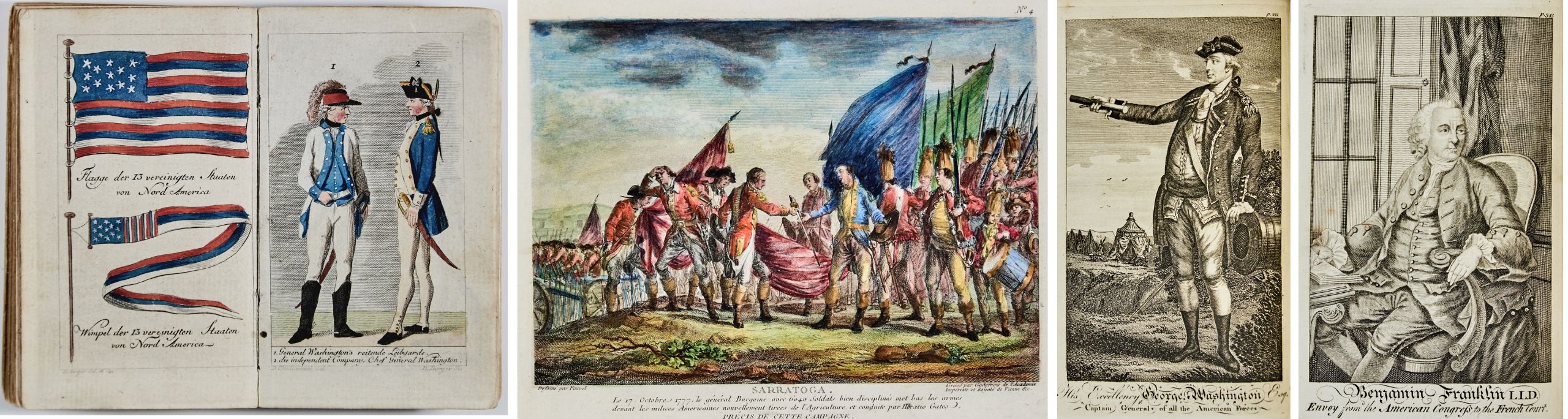
The printed works that follow detail how the conflict took narrative shape during and after the Revolution, while also preserving visual interpretation. Edmund Burke’s An Impartial History of the War in America (London: 1780) offers a contemporary account of the Revolution that is far from impartial - Burke being a supporter of the American cause for independence (Lot 4). The work also contains striking, full-length engraved portraits of George Washington, Benjamin Franklin, John Hancock and other major figures of the Revolution. Published shortly thereafter, Recueil d'estampes représentant les différents événements de la guerre qui a procuré l'indépendance aux États-Unis de l'Amérique (Paris: 1784) was one of very few works to provide contemporary visual representations of the Revolution (Lot 7); it is also cited by Wright Howes, one of the foremost Americana bibliographers, as the “First French book with a title page mentioning the United States,” a significant marker of diplomatic recognition for the time. Another work from France is a charming early 19th-century bonbonniere, which includes a dashing, full-length lithographic hand-colored portrait of Washington, attesting to his enduring presence in the French imagination (Lot 15).


In Germany, Matthias Christian Sprengel’s Historisch-genealogischer Calender (Leipzig: 1784) for 1784 similarly reflects the Revolution’s absorption into European historical consciousness (Lot 6). Most notably, the work includes the first accurate published representation of the American flag. It is rendered in a compelling hand-colored engraving with thirteen alternating red, white, and blue stripes, reflecting a contemporary description by Benjamin Franklin and John Adams while serving as diplomats to France: “The flag of the United States of America consists of thirteen stripes, alternately red, white, and blue; a small square in the upper angle, next the flagstaff, is a blue field, within thirteen white stars, denoting a new constellation.” By the time of Charles Stedman’s History of the Origin, Progress, and Termination of the American War (London: 1794), a work written by a Loyalist who had served under William Howe’s command, the Revolution had begun to settle into retrospective account (Lot 9).


The legacy of the Revolution endured in the political tensions of the early republic, most notably in the rivalry between Aaron Burr and Alexander Hamilton. The sale offers various works relating to this contentious political rivalry, such as the rare A View of the Political Conduct of Aaron Burr (New York: 1802), a scathing work on Aaron Burr as Vice President (Lot 10). Other works of the period are An Oration, Commemorative of the Late Major-General Alexander Hamilton (New York: 1804), an impassioned eulogy for Hamilton delivered by John Mitchell Mason on July 31, 1804 (Lot 11); as well as an issue of the New-York Spectator from 1804 announcing Hamilton’s death (Lot 13).
Together, these materials document the variety of ways in which the Revolution was understood across time and place. Further, they reveal how nuanced and evolving that understanding was, shaped not only by the events themselves but by the forms—visual, textual, and material—through which they were recorded and remembered. Now, at 250, this sale offers a window into the Revolution and its enduring legacy.
—Gabriel Flicker, Cataloguer
Books, Autographs & Maps
Auction Thursday, June 25, 2026 at 10am
Exhibition June 20 - 22