03/04/2026 General, Books & Autographs
NEW YORK, NY -- In the grand mythology of Hollywood, directors, stars, and producers often command the spotlight. Yet behind the camera stood artists whose technical wizardry made the dreams of the studio era visible on screen. Among them was Jack Cosgrove, one of the most respected special effects pioneers of the Golden Age. Over a career that spanned the 1930s and 1940s, Cosgrove helped define the visual language of epic cinema, earning five Academy Award nominations and the admiration of producer David O. Selznick, who inscribed a screenplay to him: “For Jack, who was always willing to try the impossible—and who always achieved it.”
Cosgrove specialized in matte painting and special photographic effects at a time when visual effects were achieved not through computers but through glass, paint, camera tricks, and painstaking precision. His work was instrumental in shaping the illusion of scale and grandeur that characterized epic productions of the era. His matte-painted vistas were so integral to production design that they were known within production circles as ‘Cosgrove shots.” He received Academy Award nominations for his contributions to such landmark films as Gone with the Wind (1939), Rebecca (1940), The Pride of the Yankees (1942), Since You Went Away (1944) and Spellbound (1945).
Gone with the Wind
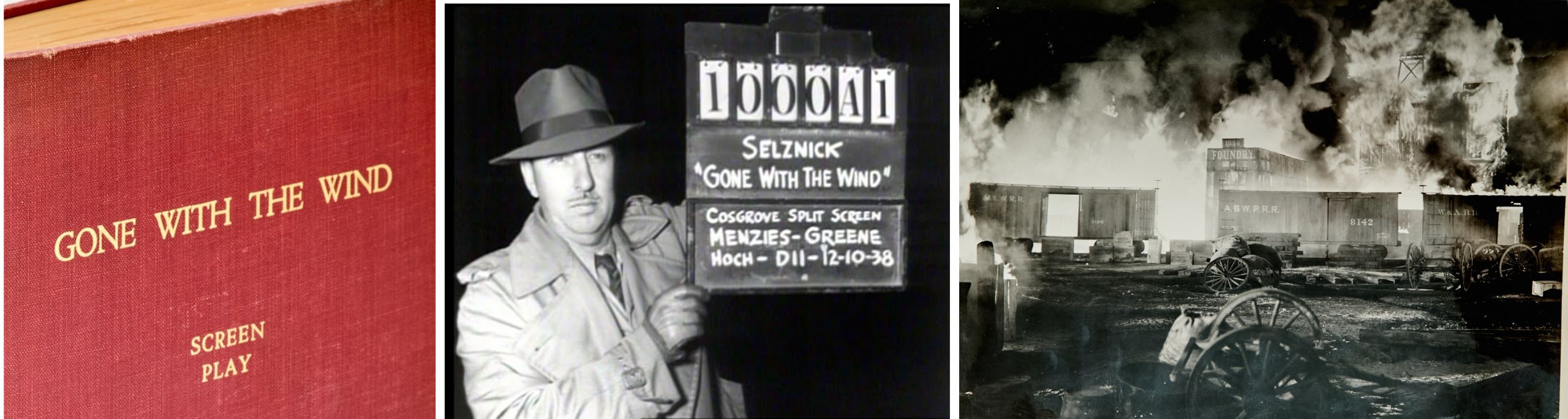
Cosgrove’s most celebrated achievement came with Gone with the Wind, the film adaptation of Margaret Mitchell’s 1936 novel. Produced by Selznick and directed primarily by Victor Fleming, the film demanded visual environments that no existing locations could fully provide. The antebellum South—its plantations, rail depots, battlefields, and especially the burning of Atlanta—was largely realized through Cosgrove’s matte paintings. These painted extensions transformed partial sets into sweeping landscapes of mythic scale. The iconic inferno sequence, which combined the burning old sets on the Selznick lot, miniatures and matte paintings, remains one of early Hollywood’s greatest special effects achievements.
The Stage & Screen auction on March 18 brings together four fascinating lots that highlight Cosgrove’s remarkable career and his close collaboration with David O. Selznick. Together, they provide a rare glimpse into cinematic innovation during Hollywood’s golden age.


A rare presentation copy of the final shooting script of Gone With the Wind, 1939, inscribed by David O. Selznick to Jack Cosgrove, including six original gelatin silver photographs. (Lot 132)


A Gone with the Wind screen-used French Empire ormolu-mounted mahogany console, circa 1820. Positioned in a main downstairs room of Tara plantation, the console is clearly visible in the memorable scene when Mammy (played by Hattie McDaniel) tells Scarlett O'Hara (played by Vivien Leigh), “You’ve been brave so long, Miss Scarlett. You just gotta go on being strong,” moments before Scarlett pulls down the green velvet drapery from a nearby window. Both Leigh and McDaniel won Academy Awards for their performances. (Lot 133)


Jack Cosgrove's Scrapbook containing three Academy Award nomination certificates including Gone with the Wind and Rebecca; an original script for A Star is Born; a fine large format photograph inscribed by Vivien Leigh; notes from David O. Selznick; and interesting photographs and career ephemera. (Lot 134)


David O. Selznick's presentation copy of the final shooting script of Rebecca, 1939, including ten original gelatin silver photographs. Rebecca was director Alfred Hitchcock's first American project and his first film under contract with Selznick. (Lot 136)
Auction Wednesday, March 18, 2026 at 10am
Exhibition March 14 - 16