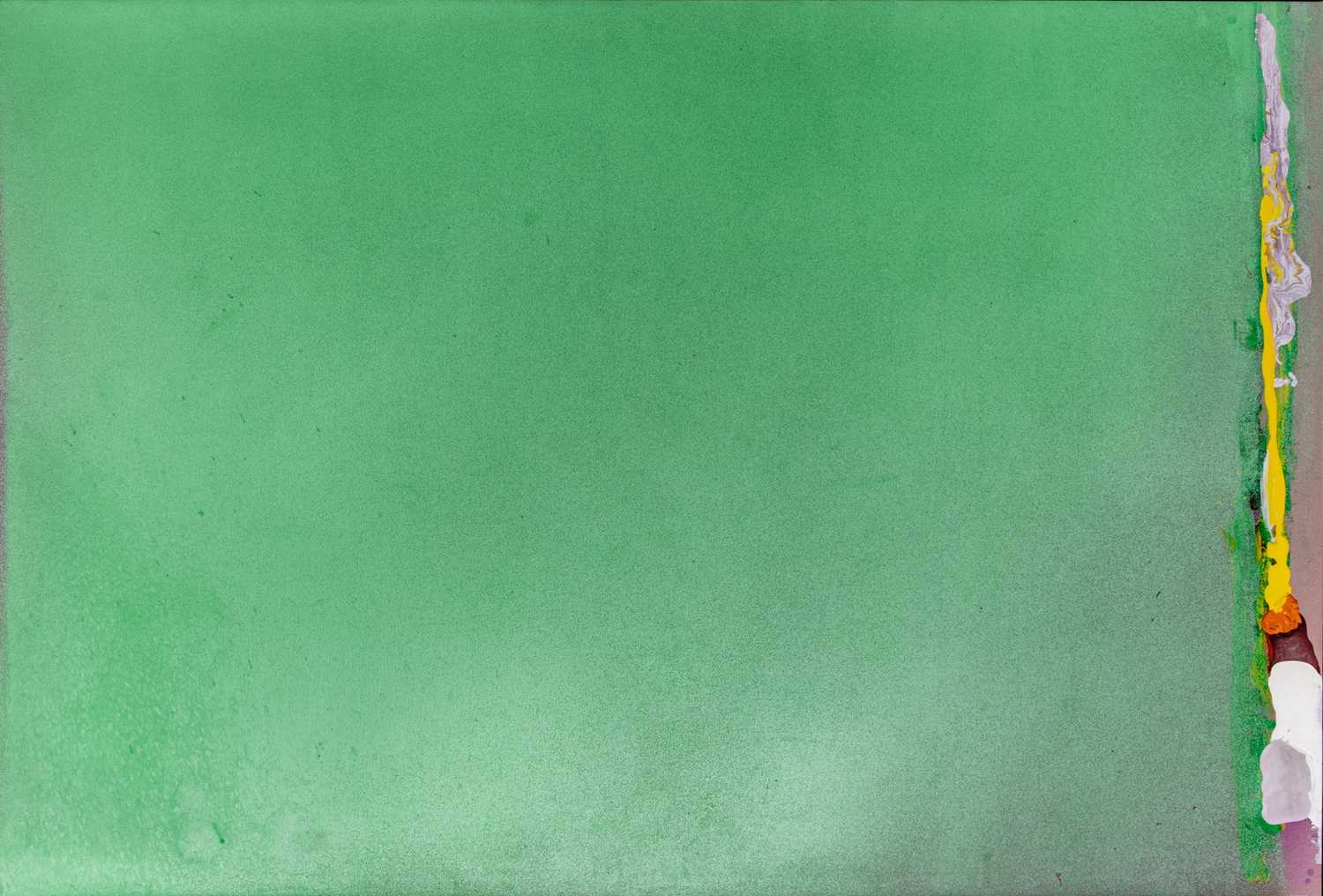
Jules Olitski
Russian/American, 1922-2007
Jules Olitski was a Russian-born American painter and sculptor whose work helped define Color Field painting in the 1960s. Known for his innovative use of color and unconventional paint application, Olitski produced canvases where pigment drifted across the surface.
Born Jevel Demikovski in 1922 in Snovsk, Ukraine, he immigrated to the U.S. as a child. He studied at the National Academy of Design in New York and later in Paris, returning to earn his degrees from New York University in the 1950s. His early exposure to European modernism and his academic training shaped a methodical yet experimental approach.
By the early 1960s, Olitski had developed his signature technique of spraying thinned acrylics onto unprimed canvas, removing brushwork entirely. These large-scale works redefined surface and space, aligning him with a new generation of abstract artists. He later explored sculpture with sprayed aluminum forms and, in his final decades, returned to more tactile, impasto-rich surfaces.
Olitski represented the U.S. at the 1966 Venice Biennale and in 1969 became the first living American artist to receive a solo exhibition at the Metropolitan Museum of Art. He remained a prolific and evolving figure in American abstraction until his death in 2007. His legacy endures through his technical innovation and unwavering pursuit of color, leaving behind a body of work that continues to influence painters exploring the boundaries of material and perception.


